First Rope Drawings (2005-2006)
I chose imagery of knotted or twisted rope to help me describe the felt but unexpressed visceral world of the mind/body. These surrogate “bodies” seemed fitting metaphors for the tension, frayed nerves and entanglements that we inevitably experience as human beings. Use of distortion and exaggerated scale help evoke less pedestrian associations with my subject while enticing viewers to linger with the sensual qualities of surface and medium.
The Hawser Series
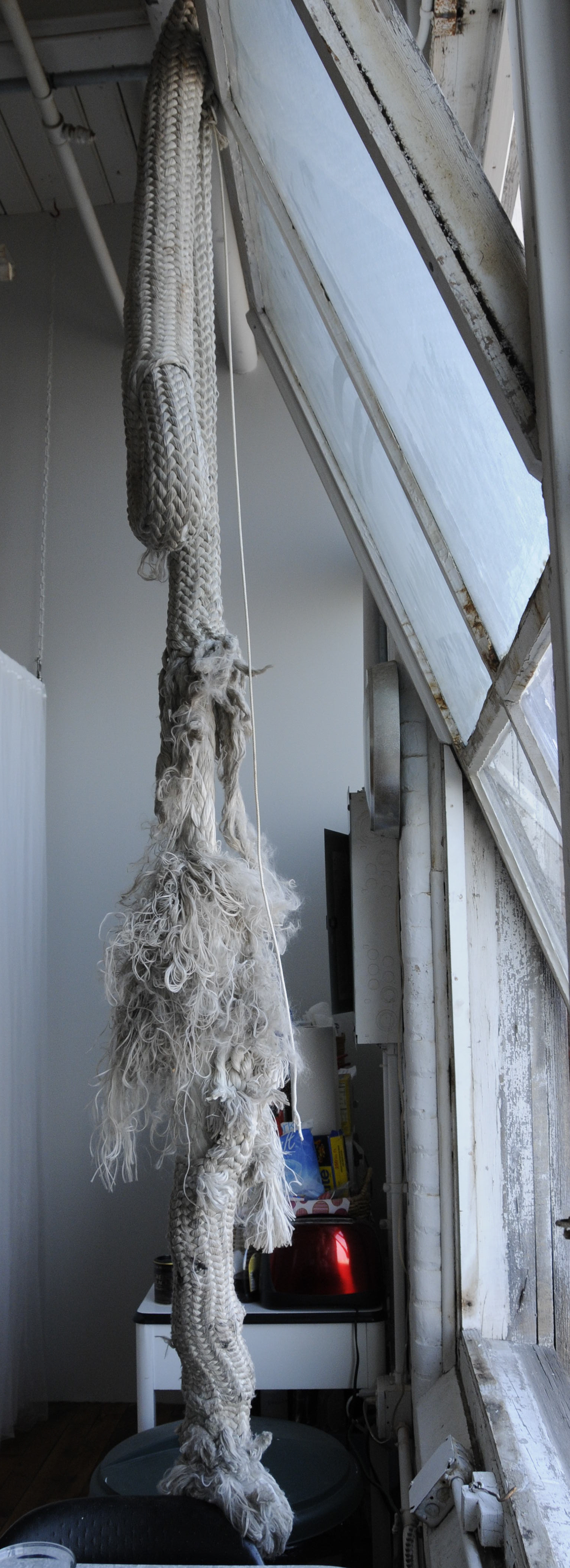
This series began in 2006 with the chance discovery of an abandoned ship’s hawser (a rope used in mooring or towing a ship) during one of my early trips to New Bedford, Massachusetts. The rope’s heft and tattered state immediately suggested an exciting series of drawing investigations. Each drawing in the Hawser Series derives from that single piece of Korean War era rope. The series encompasses twelve drawings and was completed in the fall of 2010.
In the drawings, I encountered abundant physicality: “muscle” “hairy-ness” and “sinew” which led to meditating on the many evocative rope-derived idioms and aphorisms embedded in the English language. These often referred colorfully and metaphorically to the human condition: “end of one’s tether”, “at loose ends” and “all strung out” being but a few examples. Beyond its former utility at sea, this industrial-strength tether has served anew as an elegant model for my graphical musings on the strands of our human strengths and frailties. For a list of rope aphorisms and sayings, please go here.
“Core Strength”, the first drawing in the series, is essentially a study - though I think of it more as a “portrait.” The “model” hung next to my easel from a 19 foot high ceiling beam. It was illuminated with natural light through huge studio windows inside a former textile mill. The hawser is heavy - around 75 pounds. It is 16 feet long and 12 inches in circumference. In its anatomy - simple yet complex - in its spent life, sinewy tangles and torqued curves, this rope has intrigued me with its visual and metaphoric substance.
Paper Nest Variations
The Paper Nest Variations is a series of drawings and photographs begun in 2011 immediately following the completion of the Hawser Series suite of rope drawings. See my essay "Paper Realms" in Dirty Laundry: An Independent Magazine That Amplifies Creative Voices From Contemporary Artists, Issue No. 5 - March 2014.
The idea for pursuing hornet and paper wasp nests as follow-up to rope occurred during a moment while working on the Core to Core drawing from the Hawser Series. A section of Core to Core, which is constructed entirely of repeating, tightly interwoven shapes, seemed similar to the many hexagonal chambers of a hornet nest. Although the source of the idea arrived unexpectedly, the potential this subject suggested for exciting interpretation resonated clearly. Research began immediately.
Mother Ship, the first drawing in the Paper Nest Variations, was conceived as an overview to a hidden world. A large uninhabited nest of Dolichovespula maculata - the North American bald-faced hornet - was gently sliced open, then the papery protective envelope folded back to fully reveal its complex internal structure.
The resulting display evoked much contemplation on the meanings of the term "space" - from the methodically replicated rows of larval cells to the totality of a majestic domicile suggesting a great, self-sustaining airborne craft afloat in the sky.
Approaches to continuing work have emerged from ongoing meditations in this and related directions. The drawings, and more recently the photographic works (titled Satellites) are derived from a collection of nests large and small obtained through various means - some personally collected from their sites of origin, some donated by strangers, friends and family.
The hornet and paper wasp nest subject matter is meant to engage viewers at various points: as straightforward explorative studies of remarkable material enterprise, as peeks into the ingenious architecture of their Vespidae* inhabitants, as meditations on the ingenuity of evolutionary process and species survival, or perhaps simply as portals to individual memories of a close brush with those inhabitants. Add to these the metaphoric resonance for our own human lives amongst family hierarchies, as members of mutable societies, or as travelers on an exquisitely balanced planet in space.
Drawing in Charcoal
In this everything digital era why would I persist in working in the ancient medium of charcoal on paper?
Well, for one, there is the material pleasure of dragging soft smoky sticks of charcoal over gently textured white paper. Drawing with charcoal is a tactile experience - one that can't be duplicated via computer pen and tablet. Drawing fully in the moment with the most elemental of materials is a day to day, get my hands dirty quality-of-life decision.
In terms of technical possibilities, vine charcoal** has the most beguiling property; its tones can be "pushed and pulled" on the page almost as fluidly as soft clay can be formed in the hands of a sculptor. My approach to drawing is based in classical academic or atelier style training. A fundamental of classical art education is the study and understanding of how light and shadow together create form. Drawing with charcoal allows the most direct “sculpting” of three-dimensional illusion on the page. Having worked in a broad range of creative media, I have come to the realization that I am at heart a tonal artist; I find the greatest reward in building imagery through the careful placement of areas of light and dark in relation to each other. Though I enjoy looking at color as much as the next person, it has somehow become unimportant in my work. Tone combined with line are the essential ingredients for bringing a drawing to life; Maybe that makes me a kind of purist. In any case, it all comes back to the simple carbonized willow vine. The characteristic "smudgy" tonality of charcoal gives it exceptional expressive potential and is one of the things I love so much about working in this medium.
Huguette Despault May
*The Vespidae are a large, diverse, cosmopolitan family of wasps, including nearly all the known eusocial wasps and many solitary wasps.
**Vine charcoal is created by super-heating sticks of willow or linden inside a vacuum until they are thoroughly carbonized - (oxygen during ordinary burning would reduce the vines to ash.) The soft, medium and hard consistencies are dependent upon the type of vine or wood used.